
The Search Landscape Has Fundamentally Shifted
For two decades, ranking on Google was the gold standard of digital visibility. If your business appeared on page one, you existed. If it didn't, you were invisible. This binary was simple, measurable, and the entire foundation of digital marketing strategy for small businesses, SMEs, and startups alike.
That binary no longer holds. In 2026, the search landscape has fractured. A new class of search engine — AI-powered answer engines like ChatGPT, Perplexity, Google's AI Overviews, Gemini, and Microsoft Copilot — has fundamentally changed how buyers research, compare, and shortlist solutions before they ever click a single link.
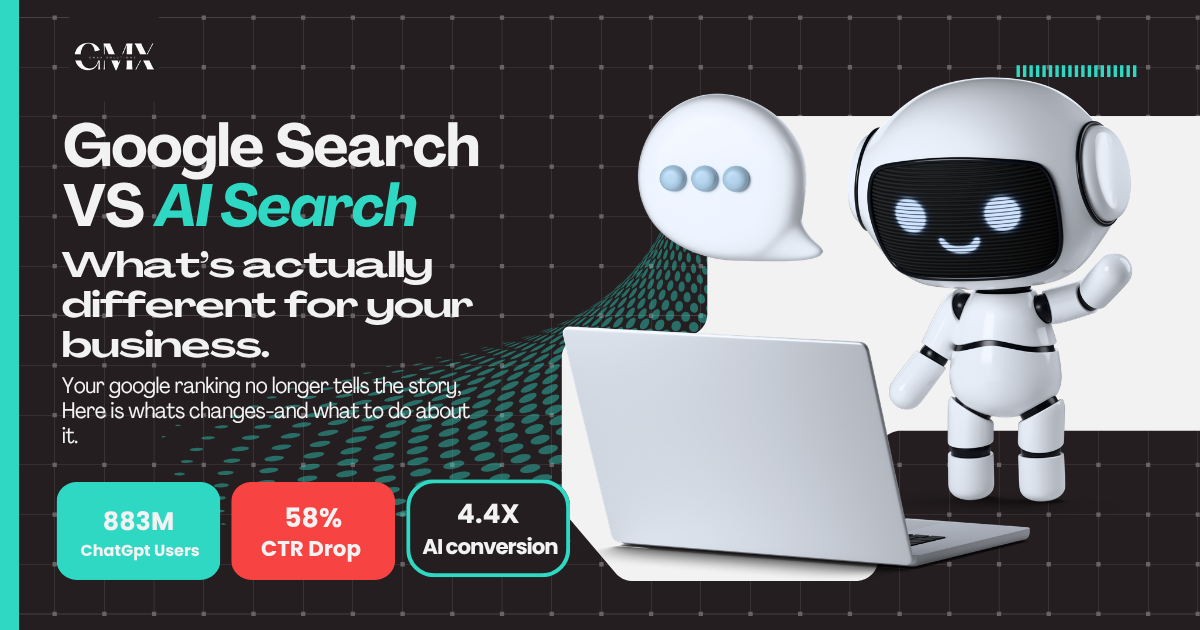
The stakes are significant. ChatGPT alone now has 883 million monthly active users. Google AI Overviews appear in 55% of all Google searches. And according to Gartner, traditional search engine volume is projected to drop by 25% by 2026 as AI chatbots absorb research queries that used to drive organic traffic. For any business investing in digital marketing — whether you are a solo SaaS founder, a small marketing agency, or an established SME — understanding the difference between AI search and traditional Google search is no longer optional. It is existential.
This guide breaks down exactly what has changed, why it matters for your business, and what you need to do differently to remain visible across both worlds.
How Google Search Works: The Familiar Model
To understand what is new, it helps to be precise about what the old model actually does. Traditional Google search is a retrieval and ranking system. When a user types a query, Google's algorithm crawls its index of billions of web pages, scores them against hundreds of ranking signals — relevance, authority, page experience, backlinks, content freshness — and returns a ranked list of links.
The user then does the synthesis work themselves. They click one or several links, read the content, compare it mentally against other pages they have read, and eventually form a view. The buyer journey under this model looked like this: Problem arises → Google search → Click links → Read pages → Build opinion → Shortlist brands → Purchase decision.
Search engine optimisation (SEO) was built to win in this model. By optimising for the signals Google's algorithm weights most heavily — authoritative backlinks, technical site health, keyword-rich content, Core Web Vitals — a business could climb the rankings and intercept buyers at the research stage.
This model still exists. Google still processes approximately 8.5 billion searches per day. SEO still matters. But it is no longer the complete picture.
How AI Search Works: The New Model
AI search engines — ChatGPT, Perplexity, Gemini, Claude, and Google's own AI Overviews — work fundamentally differently. Instead of retrieving and ranking a list of links, they synthesise information from multiple sources and return a direct, conversational answer. The user does not need to click anywhere. The AI does the synthesis work for them.
This changes the buyer journey dramatically. Under the AI search model, it looks like this: Problem arises → Ask ChatGPT or Perplexity → AI synthesises sources and builds a shortlist → User evaluates two or three recommended options → Purchase decision.
Notice what is missing: the user never independently browses a list of ten blue links. The AI has already filtered the market for them. The shortlist is built before the buyer visits a single website. If your brand is not on that shortlist, you do not exist for that buyer — regardless of where you rank on Google.
This is the single most important strategic implication for any business investing in online marketing in 2026. Your Google ranking tells you where you appear in the old game. It tells you nothing about whether you appear in the new one.
The Mechanics: What AI Search Actually Does
AI answer engines do not have their own real-time web crawlers in the same way Google does (though some, like Perplexity, use live search). They rely on a combination of their training data, retrieval-augmented generation (RAG) from trusted web sources, and in some cases real-time web search results. When a user asks 'what is the best digital marketing agency for small businesses', the AI pulls from sources it has been trained on, sources it trusts enough to cite, and real-time results if connected to the web.
The key insight is this: AI engines weight third-party citations far more heavily than your own website content. Research shows that brands are 6.5 times more likely to be cited in AI answers via third-party sources than through their own site. A mention in a respected industry publication, a detailed case study on a high-authority domain, or a consistent presence across trusted directories carries more weight in AI search than a perfectly optimised homepage.
This is the core structural difference between SEO and AEO (Answer Engine Optimisation). SEO optimises your own pages for an algorithm that reads your site. AEO optimises your presence across the broader web ecosystem for AI engines that read everything and synthesise from the sources they trust most.
The Five Key Differences Between AI Search and Google Search
Understanding the specific differences between these two models helps you make precise strategic decisions about where to invest your digital marketing budget and effort.
1. Links vs Answers
Google returns links. AI search returns answers. This sounds simple but has profound implications. In Google search, your meta title and meta description are your first impression — they determine whether a user clicks. In AI search, your brand does not get a first impression unless the AI decides to include you in its answer. The entire concept of click-through rate becomes secondary to inclusion in the answer itself.
For businesses: optimising for clicks (traditional SEO) is different from optimising for citation (AEO). You need both strategies, and they require different tactics.
2. Keywords vs Intent
Traditional SEO is built around keywords — specific phrases buyers type into a search box. AI search is built around intent — the underlying goal behind the query. A user who asks ChatGPT 'I'm a solo SaaS founder spending $2,000 a month on ads without knowing if they're working' is expressing a complex intent that would never map cleanly to a keyword in traditional SEO. AI engines can interpret and respond to that intent directly.
For businesses: content that answers specific, intent-rich questions — structured clearly enough for an AI to extract and cite — performs better in AI search than content optimised purely for keyword density. This is why FAQ sections, detailed guides, and clear factual statements have become more important than ever in 2026.
Resources like <a href='https://ahrefs.com/blog/answer-engine-optimization/' target='_blank' rel='noopener'>Ahrefs' AEO guide</a> and <a href='https://moz.com/blog' target='_blank' rel='noopener'>Moz's research blog</a> provide detailed frameworks for structuring content to perform in AI search environments.
3. Your Site vs The Web Ecosystem
Google primarily judges your own pages. AI search judges your presence across the entire web. This means that a business with a modest website but strong third-party coverage — industry reviews, media mentions, podcast appearances, case studies on partner sites, consistent directory listings — can outperform a business with a technically perfect website in AI search.
For businesses: your digital marketing strategy must now include deliberate off-site presence building. Guest articles on relevant publications, earning coverage in industry roundups, ensuring consistent entity information (name, address, website, description) across directories and aggregators — these are AEO tactics that directly improve your AI search visibility.
Platforms like <a href='https://www.semrush.com/blog/answer-engine-optimization/' target='_blank' rel='noopener'>SEMrush's AEO resource centre</a> provide practical tools for auditing your current off-site presence and identifying gaps.
4. Ranking Position vs Inclusion
In Google search, ranking position matters enormously. Position one captures approximately 27% of clicks. Position ten captures less than 3%. The difference between rank one and rank three is measurable and significant. In AI search, the meaningful distinction is binary: you are either included in the AI's answer or you are not. Once included, your relative position in the answer is less critical than the quality of the representation.
For businesses: the strategic goal in AI search is not to rank higher — it is to be mentioned at all. This requires a different success metric: AI citation rate, rather than search ranking position. Tools like <a href='https://www.brandwatch.com' target='_blank' rel='noopener'>Brandwatch</a> and emerging AEO-specific platforms are beginning to offer AI citation tracking as a core metric.
5. Traffic vs Influence
Google search drives traffic to your website. AI search drives influence over buyers before they reach your website. This is perhaps the most significant strategic shift. When a buyer arrives at your website from Google, they are still open-minded — they clicked because your title looked relevant. When a buyer arrives at your website from an AI recommendation, they have already been told that you are a strong option. They arrive with higher intent, higher trust, and higher likelihood to convert.
This explains a striking data point: AI-driven website visitors convert at 4.4 times the rate of standard organic visitors and spend 68% more time on site. The traffic volume may be lower, but the quality is significantly higher. For small businesses and digital marketing agencies focused on ROI, AI search is not a replacement for SEO — it is the highest-value acquisition channel emerging in 2026.
What AEO (Answer Engine Optimisation) Actually Means in Practice
AEO is the discipline of optimising your brand's presence so that AI answer engines include you in their responses to relevant buyer queries. It is not a replacement for SEO. It is the complementary layer that ensures your SEO investment translates into visibility in AI search as well as traditional search.
Here is what AEO implementation looks like in practical terms for a small business, SME, or digital marketing agency:
Entity Clarity: Making Your Brand Legible to AI
AI engines build understanding of brands through a process of entity recognition — identifying your business as a consistent, trustworthy entity across multiple sources. If your business name, description, location, and area of expertise are described inconsistently across your website, social profiles, directories, and third-party mentions, AI engines have difficulty building a confident picture of who you are and what you do.
Entity clarity work involves: ensuring your Google Business Profile is complete and consistent; standardising your business description across all directories and social platforms; creating a clear, structured 'About' page that states explicitly what you do, who you serve, and what makes you different; and building schema markup on your website that makes your entity information machine-readable.
For a digital marketing agency for small businesses or an SME marketing firm, this might mean ensuring that your core service description — 'AI-driven digital marketing services for small businesses and SaaS founders' — appears in identical or near-identical form across your website, LinkedIn profile, Google Business Profile, Clutch listing, and any industry directories you appear in.
Structured Answer Content: Writing for AI Extraction
AI engines prefer content that answers questions directly, in clearly structured formats. The most effective formats for AI citation are: direct question-and-answer sections (FAQs), numbered or bulleted lists with clear statements, and concise factual paragraphs that make a clear, citable claim in the first two sentences.
Blog posts structured as 'What is X', 'How does X work', 'X vs Y: What's the difference' — with clear, direct answers at the start of each section — are significantly more likely to be cited by AI engines than long-form narrative content that buries the key insight in the middle of a paragraph.
For guidance on structuring content for AI extraction, <a href='https://developers.google.com/search/docs/appearance/structured-data' target='_blank' rel='noopener'>Google's structured data documentation</a> and <a href='https://schema.org' target='_blank' rel='noopener'>Schema.org's markup reference</a> provide the technical foundation. The goal is to make your content easy for both humans and AI systems to parse.
Third-Party Citation Building: Earning Mentions That AI Trusts
Because AI engines weight third-party sources heavily, earning coverage in publications that AI systems trust is one of the highest-leverage AEO activities available. For a small digital marketing agency or B2B marketing firm, this means: contributing guest articles to respected marketing publications; earning inclusion in industry roundups and comparison articles ('best digital marketing agencies for small businesses', 'top marketing firms for startups'); building case studies on client websites that reference your agency by name; and appearing on podcasts and in interviews that are transcribed and indexed.
The key is not volume of mentions but quality and relevance. A single mention in a high-authority industry publication does more for your AI search visibility than fifty mentions on low-authority directories. Focus on publications your ideal buyers actually read and that AI engines demonstrably trust.
Industry resources like <a href='https://contentmarketinginstitute.com' target='_blank' rel='noopener'>Content Marketing Institute</a>, <a href='https://www.marketingprofs.com' target='_blank' rel='noopener'>MarketingProfs</a>, and <a href='https://clutch.co' target='_blank' rel='noopener'>Clutch</a> are high-authority sources that AI engines regularly cite in marketing-related queries.
Testing Your AI Search Visibility
The fastest way to understand your current AEO gap is to run a simple test. Open ChatGPT, Perplexity, and Google with AI Overviews enabled. Ask each of them five questions your ideal buyers would ask before purchasing your service. For a digital marketing agency: 'What are the best digital marketing agencies for small businesses?' 'Which marketing firms specialise in SaaS companies?' 'How do I find a reliable online marketing agency for my startup?'
Record which brands appear in each answer. Note which brands appear consistently across multiple AI engines — those are the brands with strong AEO. If your business does not appear in any of these answers, you have an AEO gap that your competitors may already be closing.
This test is free, takes fifteen minutes, and gives you a baseline for your current AI search visibility. It is the most practical starting point for any business beginning to think about AEO strategy.
Why Both Strategies Are Now Essential
The emergence of AI search does not make SEO obsolete — it makes SEO a necessary but insufficient condition for digital visibility. Businesses that invest only in traditional SEO will increasingly find that their traffic converts less well as the highest-intent buyers are being intercepted by AI answer engines before they reach Google. Businesses that invest only in AEO without a sound SEO foundation will struggle, because AI engines still draw heavily on the domain authority and content quality signals that SEO builds.
The businesses that will dominate digital visibility in 2026 and beyond are those that treat SEO and AEO as complementary disciplines within a unified digital marketing strategy:
SEO builds the foundation: domain authority, technical site health, keyword-relevant content, and the backlink profile that signals credibility to both Google and AI engines. AEO builds the superstructure: entity clarity, structured answer content, third-party citation presence, and the consistent web-wide reputation that causes AI engines to include your brand in their answers.
For small businesses and SMEs operating with limited marketing budgets, the practical implication is sequencing. If you have not yet established a solid SEO foundation, start there — it feeds AEO. If you have an established SEO presence but are seeing traffic volumes plateau or conversion rates drop, AEO is likely your highest-leverage next investment.
Google rankings tell you where you appear in the old game. AI search determines whether you appear in the new one. In 2026, you need to win both — or you are leaving your highest-intent buyers for your competitors to claim.
— Gmax Digital Solutions
How Gmax Digital Solutions Approaches AI-Era Search
At Gmax Digital Solutions, we build digital marketing strategies that address both dimensions of search visibility — traditional SEO and emerging AEO — within a single integrated system. We work with small businesses, SMEs, SaaS founders, and growth-stage startups who cannot afford to optimise for the wrong game.
Our approach begins with an AI marketing audit that identifies your current visibility in both Google search and AI answer engines for your highest-value buyer queries. From that baseline, we build a prioritised roadmap that addresses your most significant visibility gaps first — whether that is technical SEO, content restructuring for AI extraction, entity clarity work, or third-party citation building.
The goal is always the same: ensure that when your ideal customer is researching your category — whether on Google, ChatGPT, or Perplexity — your brand appears, is represented accurately, and earns the click that leads to a conversation.
If you want to understand where your business currently stands in AI search, start with our free Answer Engine Readiness Audit. It takes fifteen minutes and shows you exactly which queries your buyers are using to find your competitors instead of you.